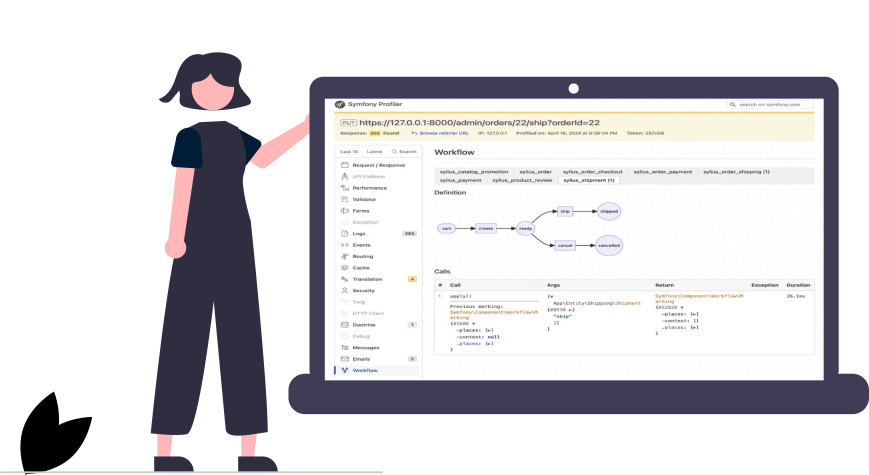
Sylius V2 has introduced several major evolutions, one of the most notable being the native integration of Symfony Workflow as an alternative to the Winzou State Machine. This update is part of a broader movement aimed at improving flexibility and ease of management for complex workflows within the Sylius ecosystem, while offering enhanced performance and integration within the Symfony environment.
Sylius and Workflows
Workflows in Sylius are at the heart of business process management, such as orders, payments, or deliveries. A workflow defines the sequence of different steps in a process while controlling transitions between them. The workflow management system is crucial for implementing complex logic in e-commerce applications.
Historically, Sylius used the Winzou State Machine library to manage these workflows. Winzou State Machine was a robust solution but sometimes considered heavy or less flexible than other alternatives.
Symfony Workflow: A Powerful Alternative
With Sylius V2, Symfony Workflow has been integrated as an alternative for managing workflows. Symfony Workflow is a native component of Symfony, a widely used PHP framework, and it offers powerful tools for defining complex business processes.
Advantages of Symfony Workflow:
- Native Symfony Integration: Unlike Winzou State Machine, which required manual integrations, Symfony Workflow fits naturally into the framework's architecture.
- Flexibility and Customization: Symfony Workflow allows configuring processes with complex transition rules.
- Flowchart Support: Symfony Workflow is designed to manage processes visually using flowcharts (graphs).
- Ease of Use: It benefits from excellent documentation and an active community.
- Extensibility: The component can be extended to include additional features such as permission handlers.
Sylius V2 and Workflow
Sylius decided to replace the old Winzou State Machine solution with Symfony Workflow for several reasons:
- Standardization: As a standard library in the Symfony ecosystem, it offers better uniformity.
- Better State and Transition Management: In Sylius, states (like "Ordered", "Paid", "Shipped", etc.) are essential for tracking an order's lifecycle.
- Compatibility with Symfony Bundles: Moving to Symfony Workflow allows Sylius to be even more compatible with the global ecosystem.
Migration from Winzou State Machine to Symfony Workflow
The migration from Winzou State Machine to Symfony Workflow can be relatively straightforward but requires some code adjustments, including:
- Redefining States and Transitions: Configurations must be adapted to be compatible with Symfony Workflow syntax.
- Event Management: Transition events must be reconfigured.
- Service and Test Adaptation: Automated tests and controllers must be updated to use the new API.
Fortunately, Sylius provides tools and guides to facilitate this migration.
Why Adopt Symfony Workflow in Sylius?
The implementation of Symfony Workflow in Sylius V2 is a welcome evolution that brings several benefits to both developers and end-users. By allowing more flexible, powerful, and integrated workflow management, this solution simplifies the development and maintenance of Sylius applications.
The migration from Winzou State Machine to Symfony Workflow in Sylius represents a strategic choice in favor of modernization and standardization of development practices.

No comments